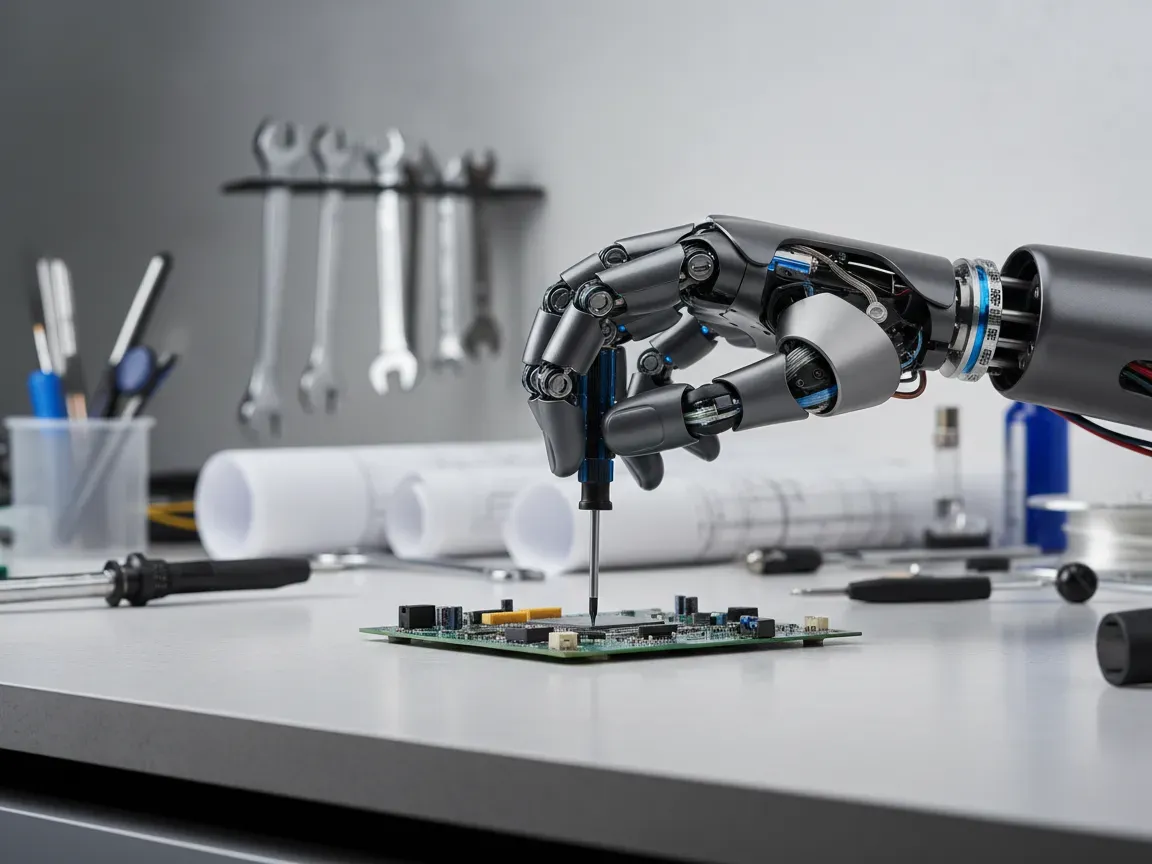
Humanoid robotics development often hits a wall when engineers move from walking to handling real world tools. Unitree Robotics has stepped into this challenge by showcasing the Dex5-S, an advanced robotic hand built to improve how machines grasp and interact with physical objects. Instead of treating the hand as an afterthought, the company engineered this modular end-effector to bring high-articulation manipulation to modern robotic platforms.
What Makes the Unitree Dex5-S Robotic Hand a Breakthrough?
The primary challenge in modern robotics has shifted from bipedal balance toward versatile manipulation. Most standard grippers in factory environments rely on basic two-finger or three-finger pinch mechanics. These designs excel at picking up standardized parts, but they fail instantly when tasked with turning a screwdriver, opening an irregular latch, or sorting mixed goods.
Unitree designed the Dex5-S to mirror the structural proportions and physical capabilities of a human hand. The breakthrough lies in packing miniature actuators, internal routing, and force sensors directly into a palm that matches everyday human measurements. By moving away from bulky external tendon systems or restrictive rigid claws, the Dex5-S offers an integrated package that mounts directly onto robot forearms.
This design allows humanoids to transition from scripted demonstration routines into practical dynamic work. Instead of swapping physical tools for specialized clamp heads, robots equipped with human-sized hands can utilize the same hand tools, levers, and handles built for human workers.
Cross-Platform Compatibility Across G1, H1, and H2 Humanoids
A major operational strength of the Dex5-S is its modular architecture, engineered to fit across Unitree’s evolving humanoid lineup. Rather than developing isolated manipulation hardware for each specific robot frame, the engineering team standardized the mechanical interface and power connections.
The hardware mounts directly onto several distinct platforms:
- The compact G1 humanoid, designed for general development and agile mobility
- The full-sized H1 model, focused on heavy duty bipedal locomotion
- The upcoming H2 generation, built for complex commercial manipulation
This unified approach streamlines software integration for developers. Control algorithms trained for object manipulation on a smaller testbed like the G1 can translate directly to the heavier H1 or H2 without rewriting core kinematics. Standardized wrist mounting and communication buses minimize setup overhead, allowing research labs and factory automation teams to deploy the same end-effector across an entire fleet.
Technical Specifications and the 22 Degrees of Freedom
The core technical leap of the Dex5-S comes down to its 22 degrees of freedom (DoF). Degrees of freedom describe the independent mechanical joints that allow individual fingers, knuckles, and the palm base to pivot, bend, and splay.
High articulation changes how a robot interacts with uneven surfaces:
- Independent finger control allows multi-point contact wrapping around soft or asymmetrical objects.
- Active lateral finger movement enables dynamic pinch shifts without releasing the object.
- Coordinated thumb opposition mimics human gripping patterns, supporting both power grasps and delicate precision pinches.
These 22 DoF give the Dex5-S the mechanical range needed to conform to real-world friction requirements. Rather than crushing delicate items to maintain friction, the hand distributes contact force across multiple joints. This mechanical flexibility reduces the computational burden on motor torque controls, letting the physical structure absorb small alignment errors automatically.
Mechanical Dexterity Versus Biological Human Movement
Despite the impressive 22 degrees of freedom, mechanical systems still face major hurdles when measured against biological human anatomy. Human hands do not rely purely on rigid links and dedicated rotary motors. Biological movement utilizes complex tendon networks, passive compliance, and flexible cartilage that naturally deform to stabilize a grip.
The Dex5-S relies on rigid links, internal linkages, and geared micro-motors. This architecture can introduce mechanical backlash over continuous duty cycles. If a motor joint experiences wear, precision positioning degrades, requiring frequent recalibration.
Furthermore, biological skin plays a massive role in grasping that robotics cannot easily replicate. Human fingertips feature soft tissue that deforms on contact, vastly increasing surface area and natural friction. While the Dex5-S integrates tactile sensors to register force feedback, it still lacks the self-healing, high-density sensory matrix of living human skin. The hand must compensate through active algorithmic corrections, making rapid tactile adaptation far more computationally intensive than biological instinct.
The Economics of a $6,500 Robotic Hand
Building high-density robotic hands is an expensive manufacturing challenge, and the pricing of the Dex5-S reflects those realities. Priced at roughly $6,500 per unit, a complete dual-arm setup costs approximately $13,000 for the hands alone, before factoring in arms, legs, compute units, or sensor suites.
This cost point creates specific commercial dynamics:
- Micro-actuators, precision planetary gearsets, and integrated torque sensors keep production costs high.
- Assembly requires tight mechanical tolerances and manual calibration, limiting rapid mass-production savings.
- For research facilities and corporate labs, $6,500 represents an accessible tier compared to industrial research hands that routinely exceed $30,000.
- For widespread commercial scaling, such as warehouse packing or retail support, outfitting standard humanoids at this price tier remains a significant capital hurdle.
Until manufacturing processes achieve economies of scale, humanoid hardware costs will remain concentrated in the hands. The Dex5-S lowers the barrier compared to historical academic prototypes, but it still represents a substantial investment for commercial operations.
How Unitree Dex5-S Shapes the Future of Commercial Robotics?
The introduction of the Dex5-S marks a clear shift in how robotic platforms are commercialized. For years, robotics companies prioritized stable walking, backflips, and rough terrain navigation. Those mobility problems are largely solved, leaving dexterity as the true roadblock to economic utility.
By treating the hand as an off-the-shelf, cross-platform product, Unitree is pushing the industry toward modular automation. Companies no longer need to spend years engineering their own custom five-finger end-effectors from scratch. Instead, developers can acquire ready-made mechanical dexterity and focus their software resources on artificial intelligence, computer vision, and spatial awareness.
This availability accelerates real-world testing in manufacturing, hazardous inspection, and laboratory automation. As more units enter the field, the balance between software control and mechanical durability will become clearer.
What High-DOF Hands Mean for the Next Generation of Automation?
High degrees of freedom give machines the ability to handle human environments without forcing facilities to redesign their workspaces. When a robot can use standard doorknobs, pick up traditional hand tools, and move delicate parts, it eliminates the need to rebuild industrial workflows around specialized machine interfaces.
The true test for the Dex5-S and similar hardware over the coming years will center on field durability and component pricing. While laboratory demonstrations prove that human-like grasping is achievable, industrial adoption demands thousands of operating hours without motor failure or tendon stretch. As production methods improve and high-density actuators become cheaper, the gap between biological agility and robotic utility will continue to close.