Sagging, Cracked or Artexed: What to Do With an Old Bromley Ceiling
Ceilings fail quietly. A hairline crack, a shallow bow you only notice from the doorway, a fine grit on the furniture after somebody walks across the room above. By the time a ceiling is obviously sagging, the decision has already been made for you.
The useful question is not whether a ceiling looks tired. It is whether the plaster is still held by whatever is above it. That single answer decides between a skim, an overboard and a full strip out.
Three ceiling types under one Bromley postcode
The borough spans about a century of building practice, and the ceiling above you depends on when your street went up.
Pre-1940s properties, including the Edwardian villas around Bromley town centre and the terraces in Beckenham, mostly have lath and plaster: thin timber laths nailed across the joists, lime plaster pushed through the gaps to form keys or “nibs” that harden and grip from above. The ceiling hangs on those nibs and nothing else.
Post-war and 1960s housing, including much of the Penge stock, has plasterboard nailed to the joists with scrim tape over the joins, often finished in a textured coating. Heavier than it looks, and the fixings are the weak point.
Newer builds towards Orpington and Petts Wood use taped and jointed plasterboard, sometimes two layers for fire or acoustic performance. Repairs here are a jointing job, not a plastering job, and treating them as the same thing is why so many patches show through the paint.
Signs a lath and plaster ceiling is coming to the end
Check these from inside the room, then from the loft or the floor above if you can get to the joists.
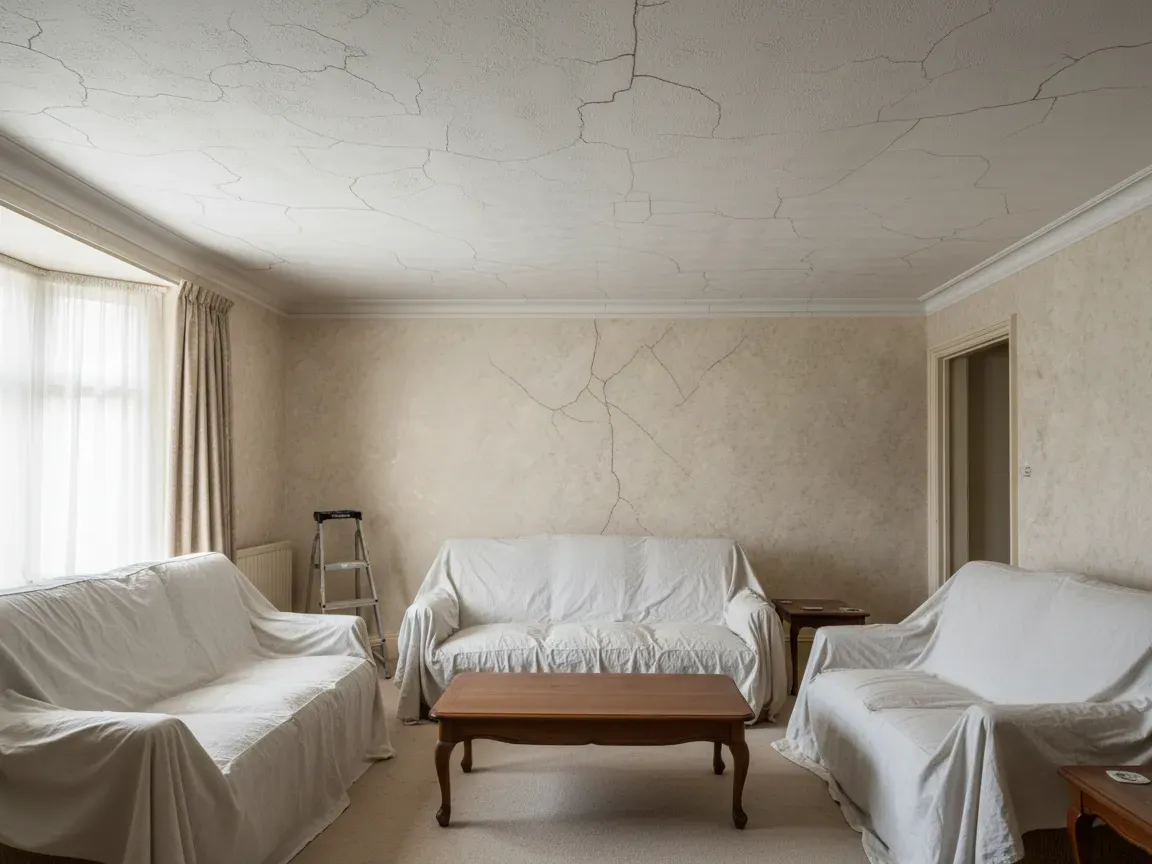
- A bow across the middle. Stand at the door and look along the ceiling towards the window. A ceiling that dips between the joists has lost keys over a wide area.
- A drummy sound. Tap with a knuckle. A live section rings dull and solid, a detached one sounds hollow, and the difference is obvious once you have heard both.
- Cracks following the joists. Parallel cracking at regular spacing means the plaster is moving independently of the timber above it.
- Grit and dust. Broken nibs drop into the void and work their way through gaps. Fine debris on top of a wardrobe or picture rail is a warning that most people miss.
- Stains around a bathroom or a flat roof. Water rots laths and softens lime. A ceiling that has been wet is never as strong afterwards, even once it dries.
One sagging patch in an otherwise sound ceiling can be cut out and re-boarded. A ceiling that sounds hollow across more than a quarter of its area is on borrowed time.
Artex: test before anyone touches it
Textured coatings applied before 2000 can contain chrysotile asbestos, because these products were on sale in the UK until the final ban that year. A small laboratory sample is the only way to know what is on your ceiling. Colour, pattern and age tell you nothing reliable.
Nobody should sand, scrape or drill a suspect textured coating until that result comes back. If the coating does contain asbestos at low concentrations, removal is usually non-licensed work, but it still needs operatives who are trained for it, sheeted containment and correct disposal, not a bag in the skip.
Where the sample comes back clear and the coating is firmly stuck, bonding and skimming straight over the texture is quicker, cheaper and far less disruptive than taking it off.
Overboard or strip out
Overboarding means screwing fresh plasterboard through the old ceiling into the joists, then skimming. It keeps the dust down, keeps the cornice in place and can be done in a day or two on an average room. It works when the joists are sound and the existing ceiling is flat enough to accept the board, and the added weight is worth checking on a long span.
Stripping out means pulling everything back to bare joists. It is dirty, it takes longer, and it is the right call where the ceiling is bowed, wet, or so poorly keyed that screws will not hold. The advantage is access: you can see the joists, run new cables, add insulation between them and pack any that have moved before the board goes up.
Where a room has decorative plasterwork, the choice narrows quickly. Before committing either way, it is worth having a qualified plasterer in Bromley inspect the ceiling from the loft side as well as the room, because the state of the keys and the joists is what makes the decision, not the appearance of the paintwork.
Cornice and ceiling roses need protecting first
Period properties in Chislehurst, Bickley and the older parts of Beckenham often carry run-in-situ cornice, ceiling roses and panel mouldings that were made on site and cannot simply be reordered from a catalogue.
Protecting them shapes the whole job. Cornice is usually cut away from the ceiling plaster along the top arris and then supported, or left in place with the new board scribed up to it. Roses come down whole if they have to come down at all. Anything genuinely beyond saving can be squeezed from a mould taken off the original profile, which is the only way to keep the pattern consistent around a room.
Losing original plasterwork is one of the few parts of this work that cannot be corrected later. Agree the approach to it before anyone starts, in writing.
Not every crack is the ceiling’s fault
Ceilings take the blame for problems that start somewhere else.
Fine cracking that reappears in the same line each winter is often condensation and thermal movement rather than structural failure, particularly in a room under a poorly ventilated loft. Cracks that open and close with the seasons usually trace back to moisture content in the timbers. A crack that widens month on month, especially near a chimney breast or a removed wall, is a job for a structural engineer before a plasterer.
Replastering over an unresolved movement problem buys you about a year of a flat ceiling, then the same line comes back.
Preparing the room saves you money
The trade charges for time, and time goes on clearing rooms as fast as it goes on trowelling.
Take out soft furnishings, curtains and anything with a fabric surface, because plaster dust carries and settles in fibres. Lift or clear the loft above a ceiling due for stripping. Book an electrician if downlighters are coming out and going back. Decide light fittings before the board goes up, since cutting holes afterwards means patching a fresh skim.
Questions homeowners ask about ceiling work
How long does one ceiling take?
Overboarding and skimming an average bedroom ceiling is typically a two-day visit. A full strip out, re-board and skim runs longer, and lath and plaster removal on its own takes most of a day.
Can we stay in the house?
Usually yes, for a single room. You lose that room and the route to it, and a strip out is noisy and dusty enough that most families arrange to be out during the removal day.
Should insulation go in while the ceiling is open?
If the joists are exposed anyway, that is the cheapest opportunity you will get for insulation and acoustic quilt between floors. It adds very little labour at that point.
Will the new ceiling match the rest of the house?
Only if the level is set deliberately. New board sits slightly below the old plaster line, so junctions at doorways and cornice need planning rather than fixing on the day.
Start with the diagnosis, not the finish
The finish on a ceiling is the last two hours of the job. Everything that determines whether it lasts happens before that: the state of the keys, the condition of the joists, the asbestos result, and whether the movement causing the cracks has been dealt with.
Ask any contractor what they found above the plaster, not just what they plan to put below it.